
The Egoscue Method: An Honest Account from Someone Who Practiced It for Years
I trained as a Postural Alignment Specialist and practiced Egoscue in England for years. Here’s what I actually found, including what it does well, and what it consistently misses.
What Is the Egoscue Method?
A Posture-Based Approach to Pain Relief
The Egoscue Method is a system of corrective exercises designed to restore proper alignment and reduce or eliminate pain. The core premise is straightforward: when your body’s joints are out of alignment, strain builds up and pain follows. Correct your alignment, and the pain resolves itself.
The key insight that separates Egoscue from most other approaches is that muscles move bones. Pain isn’t a bone problem or a joint problem. It’s a muscle imbalance problem. When certain muscles become too tight or too weak relative to their opposites, they pull your joints out of position. The joint then bears load it wasn’t designed to bear, and over time, that registers as pain.
What this means in practice: treating where it hurts rarely works. The symptom and the cause are almost never in the same place. Shoulder pain is often a hip problem. Knee pain is often caused by what’s happening above or below it, not in the knee itself.
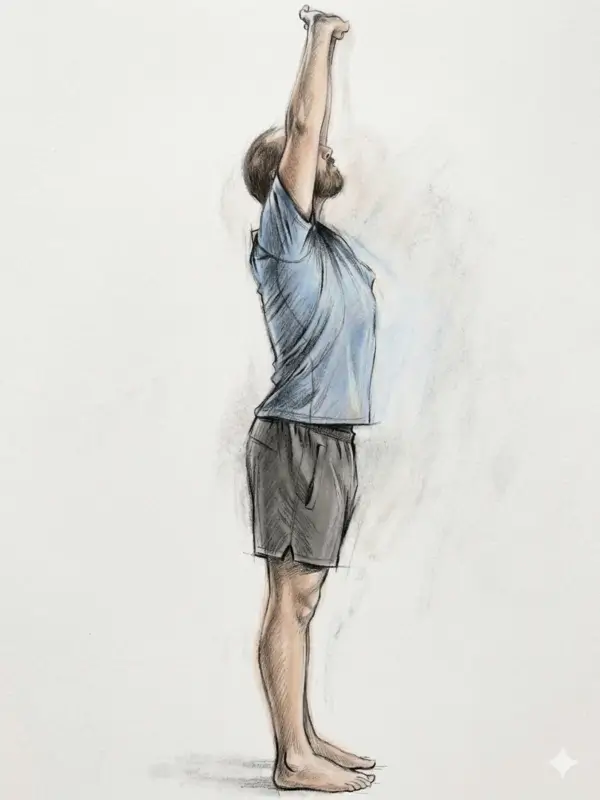
“If running causes knee pain, why do so many runners get it in just one knee? Both knees go running together.”
The Egoscue approach treats your body as an integrated unit, which is why it often helps where other approaches may have failed. It’s not chasing symptoms. It’s looking for the dysfunction that’s causing them.
How an Egoscue Session Works
Assessment, Program Design, and Corrective Exercises
An Egoscue session starts with an assessment, either in person or via photos. The Postural Alignment Specialist (PAS) looks at posture statically (standing still) and ideally dynamically (in movement). The goal is to identify which functions have become dormant and which parts of your body are compensating as a result.
From that assessment, a personalised program of corrective exercises is designed. These aren’t generic stretches. They’re sequenced specifically for your pattern of dysfunction. Two people with the same complaint of lower back pain may have completely different underlying causes, which means they need completely different programs.
Over time, dormant functions are reawakened. Your body knows what it’s supposed to do. It just needs the stimulus to remember. As function is restored, the compensations unwind, and symptoms tend to resolve on their own.
Egoscue appeals to people because it’s logical, drug-free, and empowering. You’re not dependent on a practitioner doing something to you. You’re doing the work yourself, with guidance.
The Core Concept Behind Egoscue
Compensation: Why Pain Moves Around
One of the most useful ideas in Egoscue, and one that holds up well beyond the method itself, is compensation. When one part of your body stops functioning as it should, another part takes over. The job still gets done, but far less efficiently than it was designed to.
Think of a workplace where one person stops pulling their weight. For a while, colleagues absorb the extra load. They manage. But it isn’t sustainable, and eventually something gives. That’s what’s happening in your body when a pain keeps returning, or when treating one area seems to shift the problem somewhere else.
Compensation also explains why pain is so often not where its cause is. The area that hurts is usually the part that has been compensating longest. Treat that area and you get temporary relief. But the underlying dysfunction that created the compensation is still there, which is one reason why the pain comes back.
This is where Egoscue does genuinely useful work. By addressing your dysfunction rather than your symptom, it breaks the compensation cycle rather than just managing it.
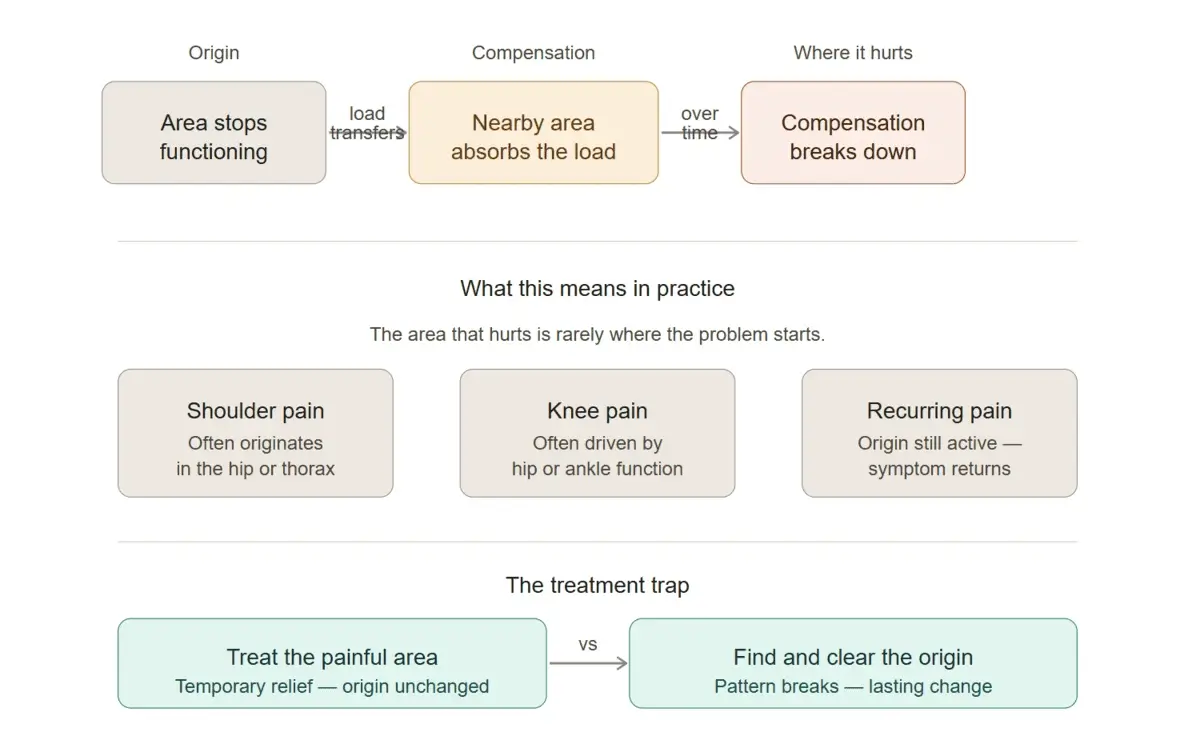
Over years of practice, I began noticing something that the compensation model didn’t fully account for. Some clients had genuinely poor posture and no meaningful pain. Others were in significant pain despite alignment that looked reasonable. The structural picture didn’t add up on its own.
That mismatch pointed to something deeper, and it became one of the central threads I kept pulling. What I eventually found forms the basis of the work I now do, and is explored further below. If you’re someone who’s tried postural or structural approaches and found them helpful but not quite enough, the section below is probably the most important part of this page.
Try This Now
A Quick Egoscue-Style Posture Assessment
Stand up in your normal, comfortable position and notice the following.
Where is your weight?
Close your eyes. Is your weight more on your left foot or right? More on your heels or the balls of your feet? More on the inside or outside edge of each foot?
Which way do your feet point?
Look down. Do they point straight ahead, or does one or both turn out? Do they turn equally, or does one turn more than the other?
What about your knees?
Do they face straight ahead, or do they turn in or out? The knees reflect what’s happening in the pelvis and are one of the clearest indicators of dysfunction further up.
Are your shoulders level?
Look in a mirror. Is one shoulder higher or further forward than the other? Now look at your hands. Can you see the back of one hand more than the other? That asymmetry is your body showing you its compensations.
Stand on one leg.
Did you wobble, lean, or rotate at the hips? Now switch legs. Was it easier or harder? If it wasn’t the same on both sides, that’s a compensation pattern.
If you noticed asymmetry in any of the above, your alignment is off. That doesn’t make you unusual. Most people have significant dysfunction they have simply adapted to. The body is remarkably good at compensating. Until it isn’t.
Egoscue Conditions and Symptoms
What the Egoscue Method Can Help With
If your symptoms are rooted in muscle imbalances and postural dysfunction, Egoscue corrective exercises can make a meaningful difference. The list of conditions it successfully addresses is broad:
- Lower back pain
- Neck pain
- Mid and upper back pain
- Shoulder pain
- Rotator cuff injuries
- Hip pain and groin pain
- Knee pain and runner’s knee
- Sciatica
- Scoliosis
- Ankle and foot pain
- Plantar fasciitis
- Carpal tunnel syndrome
- Tennis and golfer’s elbow
- Herniated discs
- Recurring headaches and migraines
- General stiffness and reduced mobility
Egoscue works at the structural and muscular level. It does that well. But it has a ceiling, and for many people with long-standing or persistent symptoms, that ceiling becomes apparent after some initial progress.
The reason is that posture is often a result, not a cause. The misalignment you can see in your body is frequently the expression of something else that’s holding it in place. You can work on the structural expression of it. But if you don’t address what’s generating it, the pattern tends to return. This is the territory that my current work operates in, and it’s explored in the section below.
What Egoscue Consistently Misses
When the Structural Layer Isn’t Enough
Years of practice left me with a question I couldn’t answer through Egoscue alone: why did some people with genuinely poor posture have no pain at all, while others with relatively good alignment were suffering significantly?
The body was telling a more complex story than the postural model could account for. There were patterns that showed up in the energy of a session, in the quality of someone’s presence, in the way certain problems had resisted everything for years. My instincts kept pointing somewhere the exercises couldn’t reach.
That eventually led me to the work of Dr. Kam Yuen, a Chinese-American martial artist, engineer and chiropractor who spent decades developing a way of working directly with your body’s energy system. Not as a metaphor. But as a practical, repeatable process for locating and clearing specific energetic weaknesses at their actual source.
What this revealed is that the sources of physical symptoms are far more varied and surprising than most people expect. The assumption is that pain has either a physical cause or an emotional one. But the territory Dr. Yuen’s approach covers is considerably wider: inherited patterns passed down through family lines, influences from other times and dimensions of experience, energetic disconnections between parts of the body that should be in relationship with one another. Sources that no amount of postural correction would ever find, because they don’t exist at the structural level.
This isn’t easy territory to write about plainly, because it sits well outside what most people have been taught to consider. But I would rather place that stake in the ground clearly than soften it into something more palatable. If you’ve been working on something for years without resolution, the reason it hasn’t resolved is almost certainly that you haven’t yet found where it actually starts.
“Posture is one piece of the puzzle. For many people, it isn’t the missing piece.”
And if you’re reading this and feeling cautious about that: the question worth sitting with isn’t whether this fits your current model of how the body works. The question is whether you want to keep working at the level where you’ve already spent years, or whether you want to try something that goes to where it actually starts.
Shuna Marr was an Egoscue client of mine years ago. She got what she needed and moved on. Then, over a decade later, she came back. The pain had returned. She’d tried various things. Nothing had shifted it.
I encouraged her to try a different approach this time. She was cautious. She agreed to a free 15-minute session using my current work.
The next morning, she sent this:
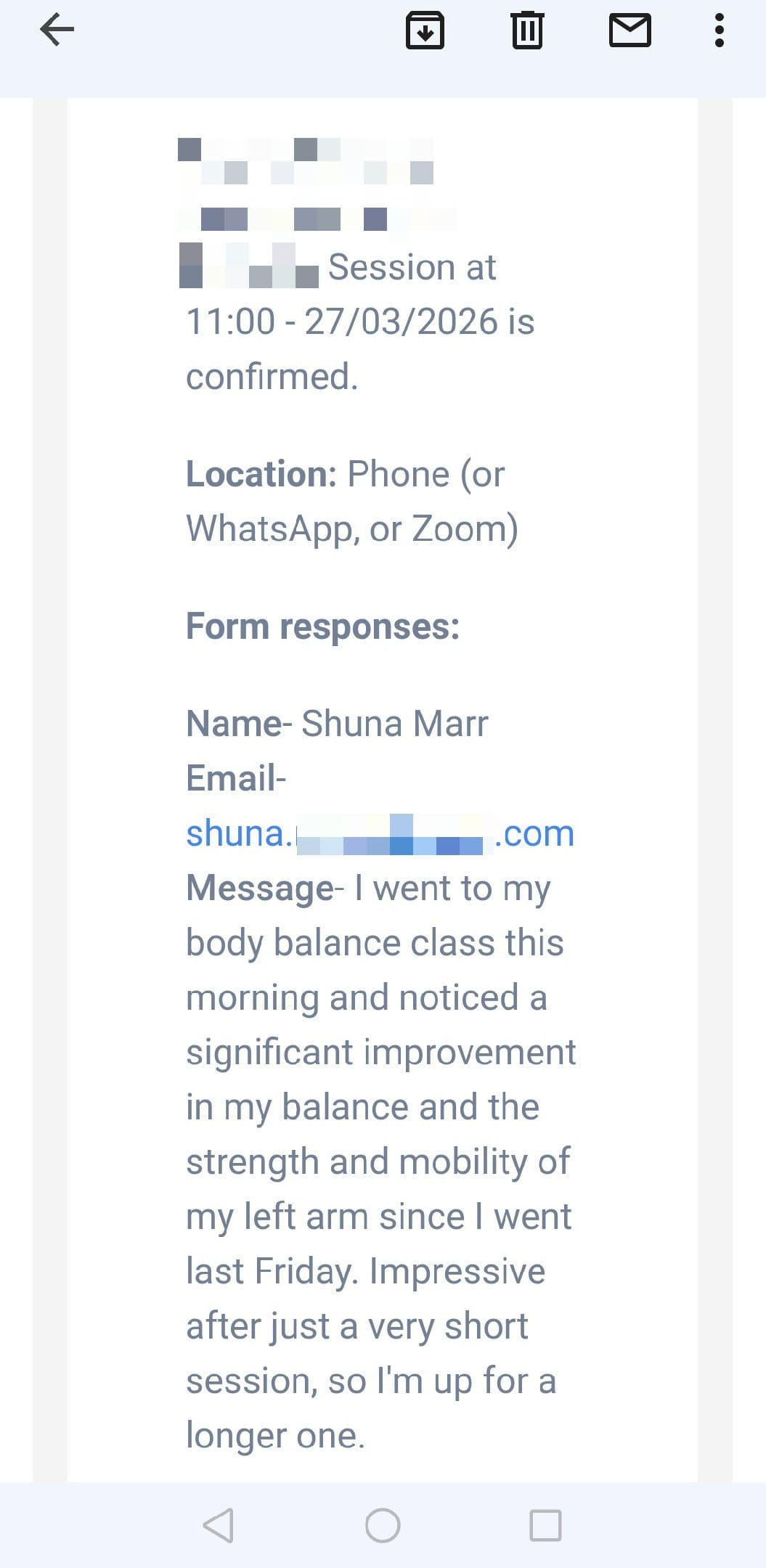
Shuna’s message the morning after her free 15-minute session
She went on to book a full session. In that session, working with the energetic relationship between specific vertebrae and the surrounding structures, something shifted in real time. At the precise moment the work reached a particular point in her cervical spine, the tingling and sensation that had been running down her left arm simply stopped. Not gradually. Immediately. She noticed it before I said anything.
That’s not what postural correction produces. That’s what happens when you find where something actually starts.
Egoscue as Part of a Deeper Process
How I Work With Egoscue Today
I no longer offer standalone Egoscue sessions. The work I do now operates at the level described above. When posture and structure are genuinely part of the picture, addressing them makes sense. But as one layer, alongside the deeper work, not as a destination in itself.
For clients already working with me, I sometimes create photos-based corrective exercise programs as a supporting element. You send a set of photos, I assess and design a program, and you work through it alongside the energy and consciousness work. The combination addresses both the structural expression of a problem and what’s generating it.
“Prior to finding Matt and the Egoscue Method, I was suffering from daily chronic pain for at least the last 5 years: lower back, mid back, shoulder, knee, neck, ankle. Since I began only two months ago I have seen about an 80% reduction in pain on a daily basis. I have even had a period of nearly three weeks when I was completely pain free.”Alison Thompson, Project Manager
If you’re specifically looking for a standalone Egoscue PAS in the UK, there are others who offer that. If you’re open to going deeper, that’s the conversation worth having.
Ready to Go Further?
Experience the Work Directly
If what you’ve read here has resonated, the next step is straightforward. A free 15-minute session is where it starts. You bring something specific. We work on it. You notice what happens.
No amount of reading quite replaces that.