

It’s an unsettling feeling when you can’t take a full breath. And for most people who find this page, it’s not a posture problem. Here’s what I’ve learned — and what actually helps.
I first wrote this article as a posture piece. At the time, I worked with the Egoscue method — a postural therapy approach — and I saw everything through that lens. Tight diaphragm, restricted ribs, poor spinal alignment: these were the things I understood, and the exercises I shared reflected that.
For some people, they helped. The comments that accumulated on this page over the years are proof of that. But here’s what else those comments showed me: if you’ve landed here, chances are it’s not because of posture.
You’re here because of anxiety. Because of stress that’s taken up residence in your chest. Because something emotional is sitting in your body and not moving. Because you’ve been to the doctor, had the tests, been told everything’s fine … and you still can’t take a full breath or get any sense of relief from it.
Posture can be part of the picture. The exercises later in this article are still useful if that’s true for you. But if they haven’t fully fixed it, or if the tightness keeps returning, it’s almost certainly not a posture problem.
This is what I’ve come to understand over years of working with people: a symptom that lives on the physical level doesn’t necessarily have its root there. Reaching for a physical solution when the cause is emotional, or energetic, or held somewhere deeper — is a bit like rearranging your desktop when there’s a corrupted file buried in the system. You can do it indefinitely and the problem will keep returning.
The Pattern That Kept Showing Up
Over the years, this page gathered dozens of comments from people describing what they were experiencing. Reading them as a collection is instructive, because the same picture appears again and again.
Shallow breathing that appeared after a period of intense stress. Difficulty breathing that followed a traumatic event or emotional rupture. The sense of not being able to take a full breath despite lungs that doctors confirmed were clear. Yawning repeatedly and never quite completing it. A chest that felt locked, heavy, or permanently braced.
Here’s a small selection of what people shared:
These aren’t outliers. They’re the majority. And what they point to is consistent: the breath is one of the most direct expressions of the nervous system’s state. When something unresolved is held in the body, breathing is often where it shows up first.
A note worth stating clearly: if you have any concern that your breathing difficulty has a medical cause, please see a doctor before assuming it’s stress or posture. Several people in the comments above had done exactly that and been told their lungs were clear. That’s useful information — it rules things out. But if you’ve had that conversation and you’re still stuck, read on.
The Problem With a Single Lens
When I was working primarily with postural therapy, posture was my answer to most things. Not because I thought it was the only answer, but because it was the tool I had. You see what you’re equipped to see.
The same is true of most approaches. A CBT therapist works with thought patterns. A somatic therapist works with the body’s held responses. A breathwork facilitator works with the breath itself. All of these can genuinely help. And none of them, on their own, reaches everything.
What I’ve come to understand — and what the work I now do is built around — is that most persistent symptoms exist across multiple levels simultaneously. The physical tightness in your chest, the anxiety maintaining it, the unresolved emotion underneath that, the inherited pattern reinforcing all of it: these aren’t separate problems. They’re the same problem expressed at different levels. And you need to work at the level the problem actually lives, not just the level that’s easiest to reach.
Shallow breathing that returns after every round of exercises is telling you something. It’s telling you the exercises are working on one level and the cause is sitting on another.
Two Exercises Worth Trying If You Can’t Take a Full Breath
If your breathing restriction feels muscular — particularly if it came on after physical strain, a period of heavy lifting, or a sudden movement — these two exercises can help reset the pattern. They were the original core of this article, and they’ve genuinely helped a lot of people.
If your restriction feels more emotional or anxiety-related, you can try them anyway. Releasing physical tension can sometimes create a little more space for the deeper work. Just don’t be surprised if the tightness returns.
Static Back Pullovers
Good for tightness that came on suddenly, or restriction that feels concentrated in the upper chest and ribcage.
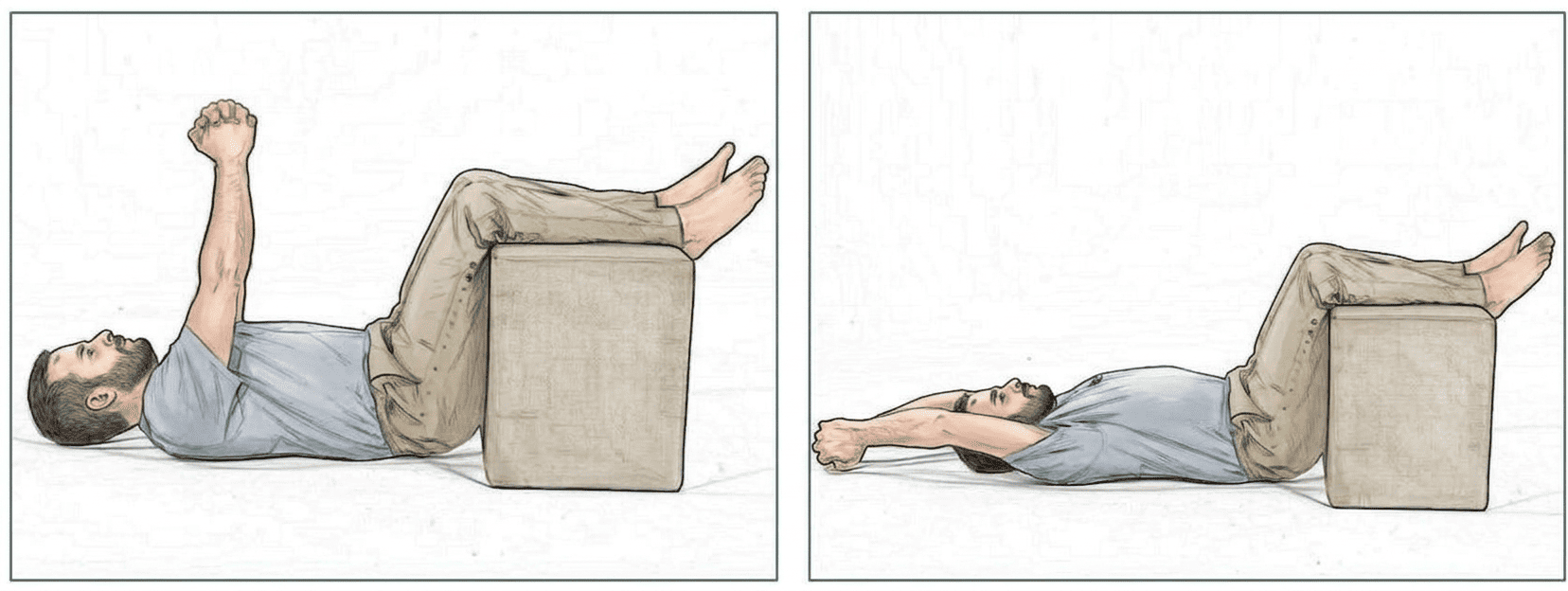
- Lie on your back with your lower legs resting on a chair or block so your hips and knees are at 90 degrees.
- Bring your arms straight above your chest, palms facing each other.
- Slowly lower your arms overhead toward the floor, keeping elbows straight.
- Pause just before your lower back arches or ribs lift, then return to the start.
- Repeat 10 to 15 slow reps, inhaling as arms move overhead, exhaling on return.
Only lower your arms as far as feels comfortable. If you feel pain or strong discomfort, stop. Do 10 reps, rest 30 seconds, then repeat if comfortable.
Modified Floor Block with Crocodile Breathing
Good for chronic shallow breathing where the pattern has become habitual. This retrains the breath to originate from the belly rather than the chest.
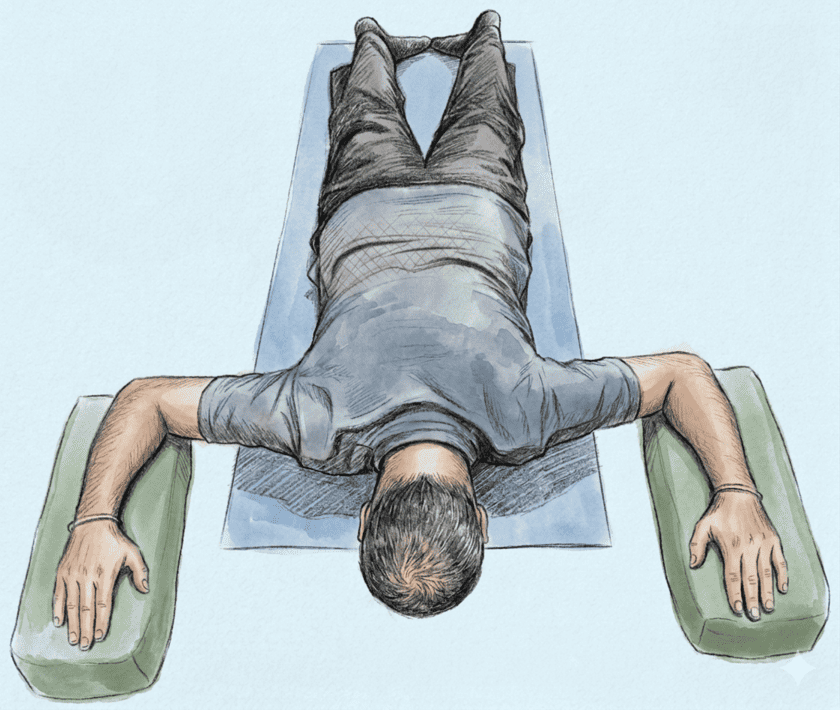
- Lie on your stomach, forehead on the floor, legs straight, buttocks relaxed.
- Turn your feet pigeon-toed: big toes touching, heels relaxed outward.
- Rest your forearms on pillows or blocks about 15cm high — let your arms stay heavy and relaxed.
- Breathe slowly and deeply into your belly: feel your stomach press into the floor, your back expand around the kidney area, your sides and ribs widen.
- Continue for around 5 minutes.
This may take practice — the belly breathing pattern often needs time to re-establish. If this position is uncomfortable due to breast tissue, try a folded towel under the chest for support. The arm position can also be lowered if needed.
What Works When the Physical Layer Isn’t Enough
If you’ve tried the exercises and felt some relief, but the restriction keeps returning — or if you’ve never been able to take a full breath no matter what you’ve tried — the cause is almost certainly sitting at a different level.
This is where the work I now do comes in. Rooted in Dr. Yuen’s framework, it works by identifying what’s actually maintaining the symptom — the specific weaknesses, at whatever level they sit — and clearing them. Not managing the tightness. Not developing coping strategies for the anxiety. Removing what’s generating the restriction in the first place.
The physical sensation of not being able to breathe is real. The anxiety it creates is real. I know both from the inside. For over thirty years I had chronic sinusitis, seasonal allergies, and exercise-induced asthma that I’d largely accepted as just how I was built. The breathing restriction that came with all of that felt physical, because it was — but it wasn’t only physical, and physical approaches only got me so far. When the underlying causes were cleared, not managed, not worked around, the symptoms went with them. That’s not something I’d have believed before experiencing it.
But the root is often neither physical nor purely psychological. It’s held somewhere underneath both, and that’s where the work goes.
“For the first time I can feel what deep breathing means. My body is relaxed for the first time. Tension in my stomach and shoulders is gone after only 10 minutes.”
— A reader, after trying the exercises above
That kind of shift — immediate, felt, unmistakable — is what becomes possible when the right level is reached. Sometimes the exercises do it. When they don’t, something deeper is worth looking at.
If the exercises help and the relief holds, that’s the whole story. You’re done. Some people find that posture really was the main piece, and once it’s addressed things settle down and stay settled.
But if you’ve tried the physical approaches — whether that’s the exercises here, breathing techniques, relaxation methods, or anything else — and you still can’t take a full breath, or keep finding yourself back at the same restriction, something else is maintaining it. Not because you’re doing it wrong. Because the cause is somewhere those approaches weren’t built to reach.
That’s not a dead end. It’s just a different starting point.
If the Tightness Keeps Coming Back
The free 15-minute session is the place to start. You bring whatever’s most present — the restriction, the anxiety, the pattern that keeps returning. I work on it with you. You notice what happens.
No assessment. No intake form. Just the work itself, so you can feel whether it’s something worth pursuing.
You Already Know: Why Your Problems Keep Returning — and How to Actually Clear Them
“Last year I cried a lot and then went to sleep. Next morning I couldn’t take a deep breath. I always yawn to take a deep breath but my yawn also isn’t complete. I’m pretty sure this is due to anxiety.”
“Can breathing problems be caused by emotional issues? In Chinese medicine the lungs house the emotions of sadness and grief. I did some journaling last night about things that happened a long time ago — and I’m having an easier time breathing today.”
“I’ve been having difficulty breathing for 12 or more years. Some days are fine and others I feel like I just can’t function. I thought it might be associated with stress.”
“Since having my baby I can’t expand my chest fully on one side when breathing. Coupled with post-partum depression, it means I didn’t get timely help.”